Tuesday, 12 September 2017

An Industrial Narrow Gauge Adventure - test #9 - The Green Diesel


Narrow Gauge Diesel Engine no. 2 - The Green Engine. Built to the scale of 1:27.7 (or 11mm = 1 foot) and running on 16.5mm Peco 'crazy track' which represents an 18 inch gauge industrial narrow gauge railway.

Image Two - The model is based on this industrial diesel 'critter' which I found on Pinterest. I know very little about the engine, but more images can be found on the Industrial Narrow Gauge Railway site here.


Image Three - I sketched up some working plans from the image on the INGR site using the 1:27.7 scale driver as reference.


Image Four - More detailed plans were drawn up on squared paper.


Image Five - The model was constructed from various thicknesses of plastic card and some sheet aluminium. The scale gauge shown has been detailed in this post.


Image Six - A lot of the detailing was guessed at, as I had very little facts about this little engine.
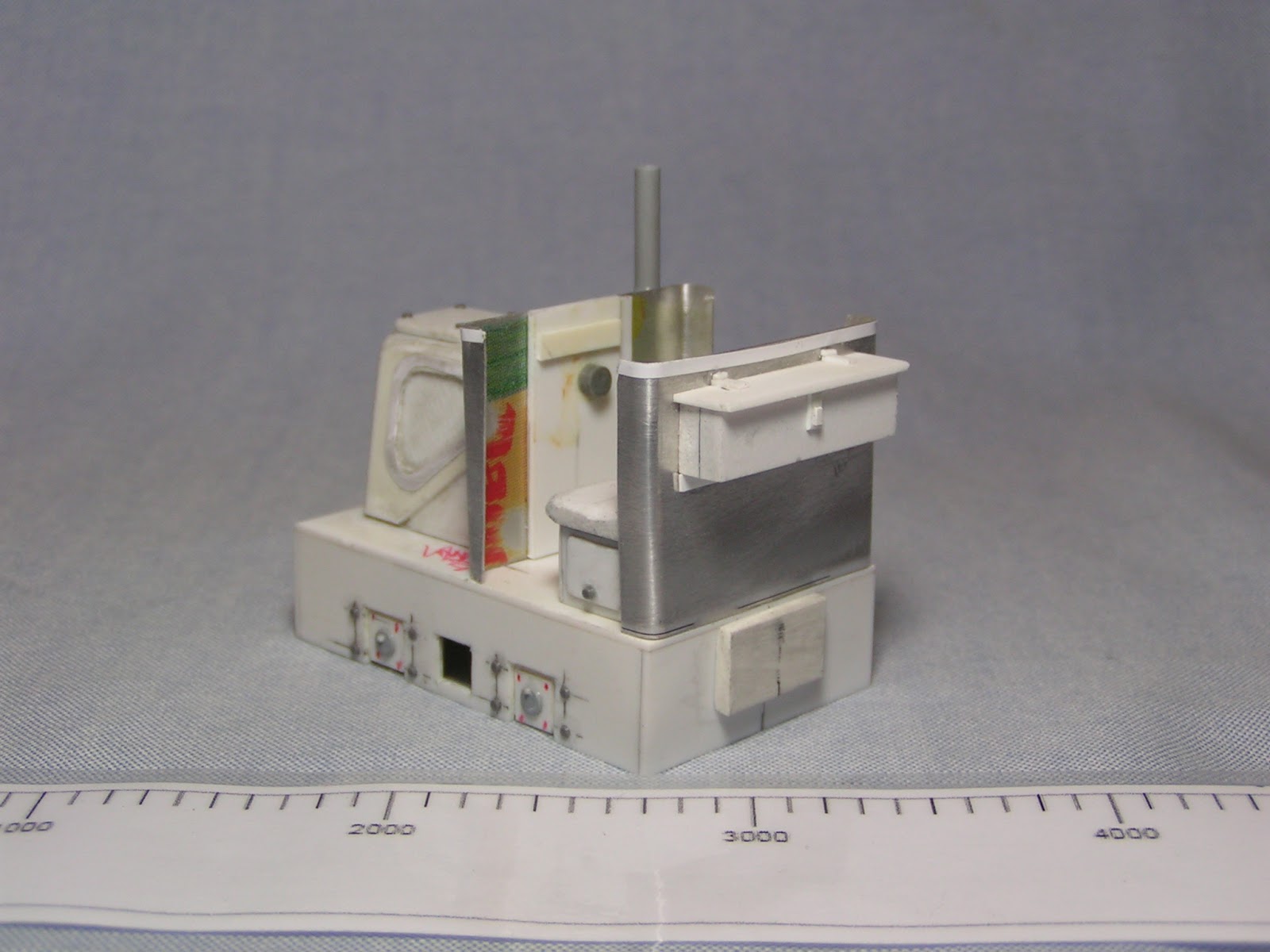

Image Seven - The aluminium sheet was cut with a pair of scissors and bent around a couple of knitting needles.


Image Eight - The exhaust pipe was cobbled together by using a metal spear (a wargame figure spear) as the part that comes out of the bonnet, a section of knitting needle (which has been wrapped in sticky-back plastic to 'beef it up a little) and a section of sprue.


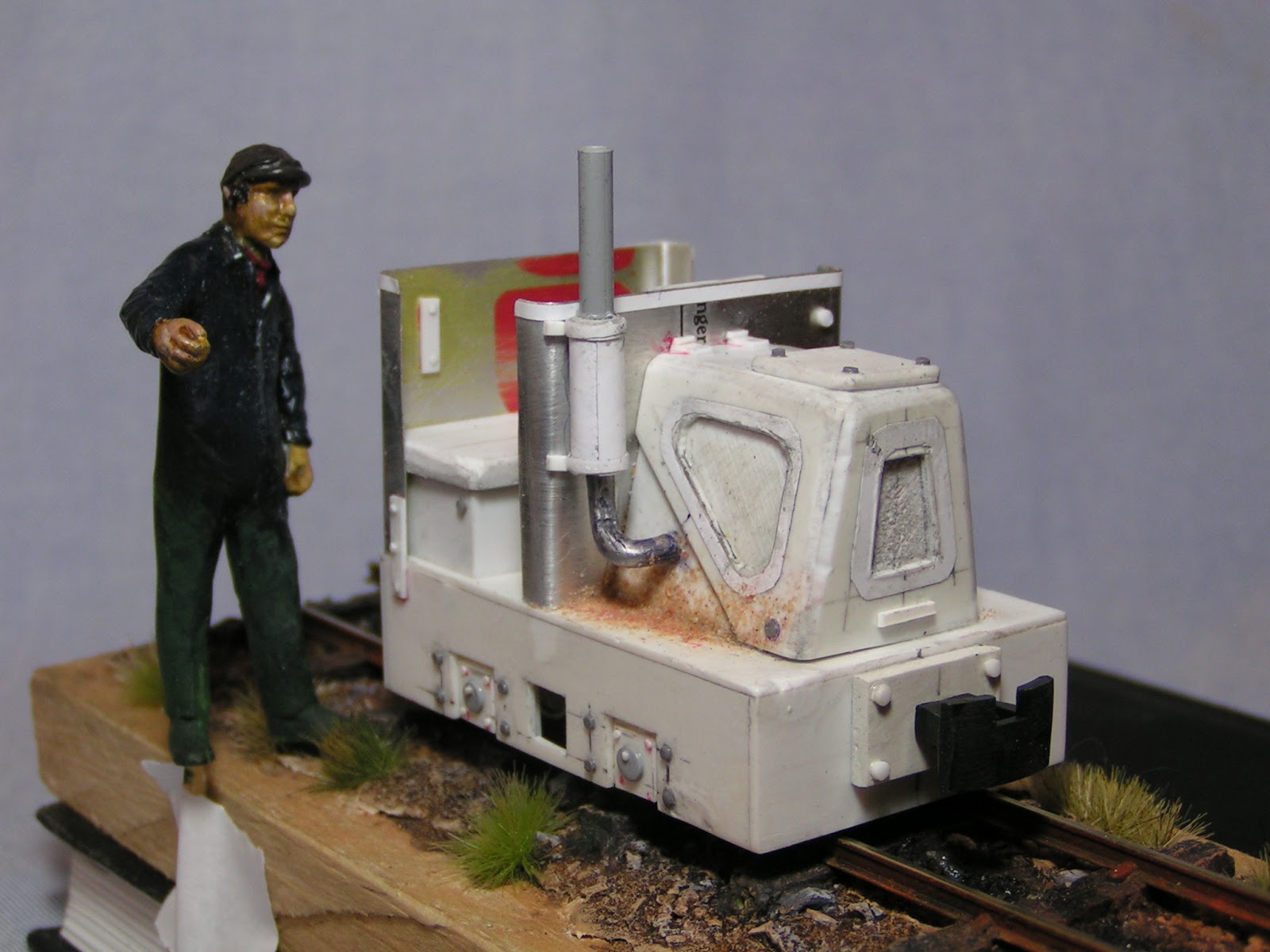
Image Nine - The engine driver alongside the model showing just how small this engine is.


Image Ten - The model show on the section of narrow gauge track. The black buffers were cut from a Gnomy toy and glued in place with superglue, a section of paperclip was used as reinforcement.


Image Eleven - I added fine sand over superglue to the chassis top and the side of the bonnet - as the initial INGR image shows a dark and grainy finish on these areas.


Image Twelve - as above.


Image Thirteen - The model runs on a Tenshodo 'Spud'. This particular spud had been stuffed into a 'spares' drawer for over ten years (maybe even 15 years) as it had a broken top and was not a very good runner. I cleaned up the wheels and the pick-ups and after some delicate repairs, I got it running again. The spud is NOT glued in place, I used plastic card to 'wedge' the spud front and back which seems to work fine.

Spud's need a lot of weight for them to work properly. I filled the bonnet with small scraps of cut up lead soldiers and fixed these in place with superglue. The chassis was further weighted with pieces of lead as can be seen in the image below.

I can report that The Green Engine runs perfectly.


Image Fourteen - The model displayed on the section of narrow gauge track and alongside the first engine driver, shown for scale.

The Green Engine is 60mm long (82mm over buffers), 38mm wide and 60mm tall (to top of the exhaust).

In part two I will give details of how the model was painted and weathered.

Tony

Monday, 11 September 2017

Von Mohnblume Line - part four


The bases have been further detailed or textured by adding sieved stones and sand over uPVA glue.

Image Two - The command group of drummer, standard bearer, officer and sergeant. Note the added cuff buttons sculpted from Milliput.


Tony

Sunday, 10 September 2017

An Industrial Narrow Gauge Adventure - 5.5mm and 7/8th narrow gauge modelling

While conducting research on both 18 inch narrow gauge railways and obtaining information and inspiration for my planned narrow gauge shelf layout or 'micro layout' I have come across a number of interesting sites and pieces of information that I will be using as part of this long-term project.

Firstly, my chosen scale of 1:27.7 or 11mm = 1 foot is exactly twice as big as the recognised narrow gauge scale of 5.5mm = 1 foot for details see this link. It is almost exactly half as big as another modelling scale - 7/8th = 1 foot and for details of this combination see this link. 7/8th is just over 22mm = 1 foot.

I also spotted this 1/25th scale narrow gauge layout running on 16.5mm track on this site. see Castle Works Shed. Which reinforces my belief that the 11mm = 1 foot option is a goer as well as giving me the push to produce a 'tuning fork' layout (a simple layout with just one turnout or switch) for more information see this link.

Then earlier this week I found a video link/interview that talked to Carl Arendt the founder of a railway modelling group that concentrates on Micro Layouts. For details see this You Tube link.

So the plans are firming up. A 1:27.7th scale narrow gauge layout with scratch built terrain and scenery as well as modified or scratch built engines and rolling stock running on 16.5mm Peco 'crazy track', all compounded into a micro layout about 4 feet square.

If only there were eight days in a week or 25 hours to a day!

Stay tuned for future updates.

Tony

Saturday, 9 September 2017

Aircraft of the Fighting Powers - a charity shop find


Sue and I had a morning at Avoncroft Museum yesterday and after we had browsed the display buildings and exhibitions we drove into Bromsgrove where Sue found this second hand marvel - Aircraft of the Fighting Powers volume V from 1944.

It was for sale at just £1.99 in a charity shop.


Over 70 fully illustrated and beautifully drawn scale plans with accompanying details - a real bargain. Here are just a few of the scale drawings included in this book.


Tony

Friday, 8 September 2017

Von Mohnblume Line - part three


I added Milliput to the 2p coins to blend in the metal bases. As you can see I have added small Milliput stones to the groundwork as well as a tiny piece of customisation - Milliput buttons to the Pugs uniform cuffs.

Tony

Thursday, 7 September 2017

Von Mohnblume Line - part two


Part one - The miniatures needed very little cleaning up so I sanded the base bottoms smooth and mounted them on to 2p coins with superglue and accelerator. This is my preferred basing style and my only concern was should I have used a 1p coin (as the little Pugs are not that tall). I choose to stay with the more usual 2p.

The figures were sculpted by Rob Alderman  of Hysterical Games and are available in various configurations from Alternative Armies. I choose the Skirmish Pack of 10 random miniatures.

The next step is to detail the bases.

Tony

Tuesday, 5 September 2017

An Industrial Narrow Gauge Adventure - test #8 - the first driver figure


The Feldbahn featured in this earlier post needed a driver, a 1:27.7 scale miniature that would fit into the cab and look like he was actually driving the engine. I used a 1/35th scale tanker that I had seen in Military Modelling as inspiration for the pose and started the sculpt.

Image Two - The converted miniature showing the original cream plastic, Milliput and Green Stuff that was used in the conversion.


Image Three - The mini at the same stage of construction, shown from the rear. This figure is clothed in a one-piece boiler suit, rather than dungarees (as seen on the earlier figures see this post for more details).


Image Four - The nearly completed figure alongside the original 1:24th scale plastic figure that was bought from e-bay.


Image Five - The finished driver. Note the long sleeves and the flat cap now undercoated in grey acrylic paint.


Image Six - Engine Driver No.1 fully painted, although, I'm not happy with the gloss sheen. I think I will have to 'matt it' down.


Image Seven - And the final image, the driver figure doing his job. The figure is NOT glued into the cab, but just placed there so that I can A - still modify the Feldbahn (narrow gauge engine) if needed, B - re-paint him with matt varnish and/or C - Have him cast in resin by Rob Alderman at Hysterical Games. Should any reader be interested in purchasing this or the earlier three 1:27.7 scale figures, please contact me at;
dampfpanzerwagon@yahoo.co.uk


Tony